UAV Hydrogen Fuel Cell Solutions

UAV hydrogen fuel cell systems provide a pathway to longer endurance, faster refueling, and higher operational availability than battery-only power for selected UAV missions.

SOLIDHYDRO develops hydrogen fuel cell solutions for different UAV power architectures, from HYDRA-G 3.3kW onboard PEM fuel cell power for long-endurance flight and propulsion to HYDRA-M 120W solid-state metal hydride systems for UAV ground power and battery charging.

The right configuration depends on the UAV platform, required power, flight profile, payload, endurance target, hydrogen storage method, and operating environment.

Why Use Hydrogen Fuel Cells for UAVs?

Battery-electric UAVs are widely used for short-duration missions, but battery energy capacity can become a limiting factor when an aircraft must remain airborne for extended periods or operate with a significant payload.

A hydrogen fuel cell system converts the chemical energy stored in hydrogen into electricity through an electrochemical process. This allows hydrogen to serve as the energy source while the fuel cell supplies electrical power to the UAV’s propulsion and onboard systems.

For suitable mission profiles, hydrogen fuel cell systems can offer several potential advantages:

Longer Mission Endurance

Hydrogen fuel cell systems can support extended operating periods where the available energy from a battery-only architecture is insufficient for the required mission.

This makes fuel cells particularly relevant to applications such as long-endurance aerial inspection, surveillance, mapping, communications relay, and other missions where additional flight time has operational value.

Lower Refueling Downtime

Instead of waiting for a battery pack to complete a charging cycle, a hydrogen-powered UAV can be configured for rapid fuel replacement or hydrogen refueling, depending on the system architecture.

This can be important for operations requiring repeated missions throughout the day.

Continuous Electrical Power

A fuel cell can provide continuous electrical power while hydrogen is supplied to the system.

In hybrid UAV architectures, the fuel cell can provide the primary or base electrical load while a battery handles transient or peak power demands.

Suitability for Long-Endurance UAV Architectures

Hydrogen fuel cell systems are particularly relevant when the UAV mission requires a combination of endurance, payload, continuous power, and operational availability.

The appropriate system should be selected based on the complete UAV power architecture rather than fuel-cell output alone.

How to Choose a Hydrogen Fuel Cell for Your UAV

Selecting a UAV hydrogen fuel cell requires more than matching the fuel-cell rated power to the UAV’s motor power.

The complete system should be evaluated around the UAV’s mission profile, propulsion system, energy storage, payload, and operating environment.

1. Determine Required Continuous Power

First determine the electrical power required during normal flight.This should include propulsion, avionics, communications, payloads, cooling, and other continuously operating loads.
The fuel cell's continuous output should be sufficient for the intended base-load requirement.

2. Define Peak Power Requirements

UAVs can require substantially more power during takeoff, climb, acceleration, wind compensation, or other high-load conditions.
For this reason, the fuel cell does not necessarily need to provide every peak-power demand by itself.
A hybrid architecture can use the fuel cell for continuous power while a battery provides additional power during transient loads.

3. Calculate the Target Flight Endurance

The required endurance should be defined before selecting the fuel-cell system.Consider:
• Target flight duration
• Cruise power
• Takeoff and climb power
• Payload power consumption
• Reserve energy
• Hydrogen storage capacity
• Expected operating conditions
The fuel-cell system and hydrogen storage system should then be sized together.

4. Evaluate System Weight and Payload

The relevant parameter is the total power-system weight, not only the fuel-cell stack.The complete UAV energy system may include:
• Fuel-cell system
• Hydrogen storage
• Regulators and valves
• Power electronics
• Battery
• Cooling or airflow components Mounting hardware
The final configuration should leave sufficient payload capacity for the mission.

5. Select the Hydrogen Storage Architecture

Hydrogen storage is an important part of UAV system design.
Depending on the application, the system may use compressed hydrogen, solid-state hydrogen storage, or another hydrogen-storage architecture.
Storage volume, system weight, operating pressure, refueling method, transportation requirements, and environmental conditions should all be considered.

6. Consider the UAV Airframe and Flight Profile

A hydrogen fuel-cell system should be matched to the aircraft architecture.
Relevant factors include:
• Multirotor or fixed-wing configuration
• VTOL requirements
• Cruise power
• Maximum takeoff weight
• Available installation volume
• Airflow and cooling
• Payload requirements
• Flight altitude
• BVLOS operating requirements

7. Evaluate Hybrid Battery Integration

For many UAV architectures, the most practical configuration is not fuel cell versus battery, but fuel cell plus battery.
The fuel cell can provide the continuous electrical load while the battery supports peak power, transient loads, startup, and emergency reserve.
This architecture can also help separate the requirements for endurance and peak propulsion power.

UAV Hydrogen Fuel Cell Power Architecture

A typical hydrogen-electric UAV architecture can be organized around four main components:

Hydrogen Storage → Fuel Cell → DC Power Bus → Propulsion & Avionics

The hydrogen storage system supplies hydrogen to the fuel cell.

The fuel cell converts hydrogen into electrical power, which is delivered to the UAV’s DC power system.

The DC bus then supplies power to the propulsion system, avionics, payloads, communications equipment, and other onboard loads.

For hybrid UAVs, a battery can be connected to the DC bus to provide additional peak power and energy buffering.

Fuel Cell for Continuous Power

The fuel cell is typically suited to providing continuous or base electrical power during the mission.
This is particularly useful for long-duration flight profiles where maintaining a stable electrical output is more important than delivering short-duration peak power.

Battery for Peak Power

A battery can complement the fuel cell during:
•Takeoff
•Climb
•Acceleration
•Rapid maneuvering
•Transient propulsion loads
•Fuel-cell startup
•Emergency operation
This hybrid architecture allows each energy source to perform the function for which it is best suited.

Hydrogen Storage as Part of the System

The hydrogen storage system should not be evaluated independently from the fuel cell.

For a complete UAV design, engineers should consider the combined weight, volume, operating conditions, refueling process, and energy capacity of the hydrogen storage and fuel-cell system.

HYDRA-G 3.3kW for Onboard UAV Power

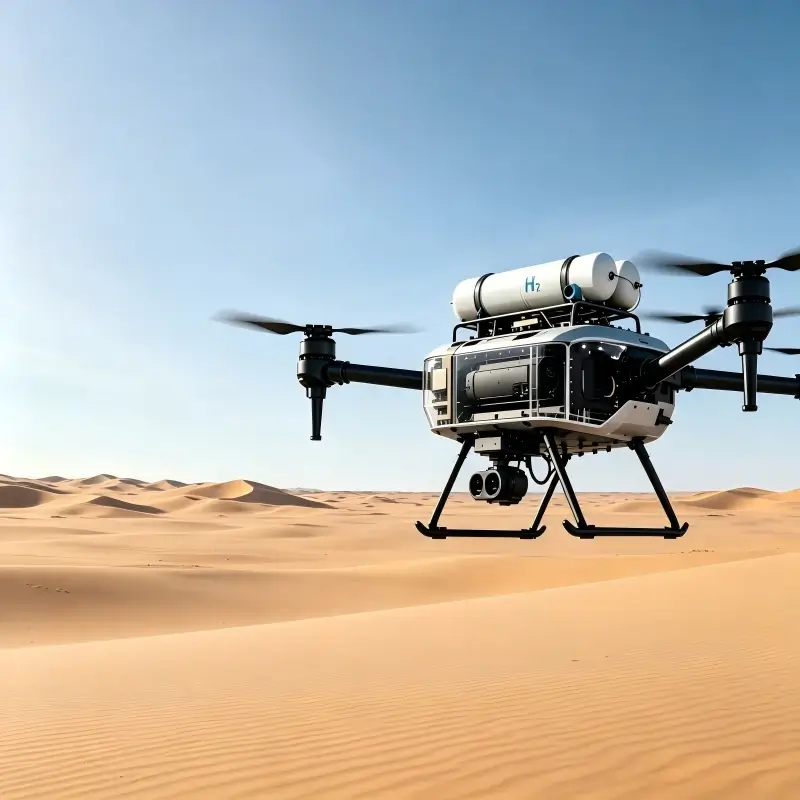
HYDRA-G 3.3kW is SOLIDHYDRO’s air-cooled PEM fuel cell system designed for onboard UAV power and propulsion applications.

It is intended for UAV platforms that require a continuous electrical power source for long-endurance flight, including suitable multirotor, VTOL, fixed-wing, and hybrid-electric architectures.

HYDRA-G can be integrated into a UAV’s onboard electrical architecture and used together with a battery when additional peak power is required.

Key HYDRA-G 3.3kW Features

3.3kW rated electrical power

Air-cooled PEM fuel cell architecture

Native 48V DC

Designed for onboard UAV integration

Suitable for long-endurance UAV applications

Compatible with hybrid fuel-cell and battery architectures

Configurable system architecture for different integration requirements

For detailed technical specifications and integration information:

Hydrogen fuel cell systems can be considered for UAV missions where endurance, continuous power, payload capacity, or operational availability are important design requirements.

UAV Hydrogen Fuel Cell Applications

Long-Endurance Multirotor UAVs

Multirotor UAVs used for inspection, surveillance, mapping, communications, and other extended missions can benefit from an energy architecture designed around continuous fuel-cell power.

The fuel cell can provide the base electrical load while a battery handles short-duration peak-power requirements.

Fixed-Wing UAVs

Fixed-wing UAVs can operate efficiently during cruise, making them potential candidates for hydrogen fuel-cell systems designed around continuous electrical power and extended endurance.

The appropriate configuration depends on cruise power, payload, aircraft size, and hydrogen-storage capacity.

VTOL UAVs

VTOL aircraft combine vertical takeoff and landing with efficient forward flight.

Because VTOL operations can require higher power during takeoff, landing, and transition, a hybrid fuel-cell and battery architecture may be appropriate for some platforms.

BVLOS UAV Operations

Beyond Visual Line of Sight (BVLOS) missions can require longer flight duration and higher operational availability than short-range UAV missions.

Hydrogen fuel-cell systems can be evaluated for applications such as:
• Infrastructure inspection
• Pipeline and power-line inspection
• Remote-area monitoring
• Mapping and surveying
• Communications relay
• Persistent surveillance
Actual endurance depends on the complete UAV system, including aircraft configuration, payload, hydrogen storage, weather, flight profile, and power consumption.

Hydrogen Fuel Cell vs. Lithium Battery for UAVs

Lithium batteries remain an established solution for many UAV applications, particularly short-duration and high-power missions.

Hydrogen fuel cells address a different part of the UAV energy-system problem: extending operating time while maintaining continuous electrical power.

FactorHydrogen Fuel CellLithium Battery
Energy source Hydrogen Stored electrochemical energy
Continuous operation Suitable for sustained power generation Limited by stored battery energy
Refueling Hydrogen replacement/refueling Battery charging or replacement
Peak power Often supported by hybrid battery Strong peak-power capability
Long-endurance missions Suitable for selected applications Increasingly constrained as endurance requirements rise
System architecture Fuel cell + hydrogen storage, often with battery Battery pack
Integration Requires fuel-cell and hydrogen-system integration Mature battery integration

The appropriate choice depends on the UAV’s mission rather than on a single specification such as fuel-cell power or battery capacity.

For a detailed technology comparison:

UAV Fuel Cell System Integration

Successful UAV fuel-cell integration requires coordination between the fuel-cell system, hydrogen storage, propulsion system, power electronics, battery, and aircraft control system.

Electrical Integration

The fuel-cell output must be compatible with the UAV's electrical architecture.Engineers should evaluate:
• INominal DC voltage
• Continuous current
• Peak current requirements
• DC/DC conversion
• Battery integration
• Motor-controller compatibility
• Power-management strategy

Thermal Management

Fuel-cell performance can be affected by ambient temperature, airflow, and system heat rejection.

The UAV airframe should provide an appropriate airflow path and installation environment for the fuel-cell system.

Hydrogen System Integration

Hydrogen storage and fuel delivery should be designed together with the fuel-cell system.Important considerations include:
• Storage method
• Operating pressure
• Hydrogen flow
• Regulation
• Leak detection
• Ventilation
• Installation space
• Transportation and handling requirements

Flight Control and Power Management

A fuel-cell UAV should account for changes in electrical load throughout the flight.The power-management system may coordinate:
• Fuel-cell output
• Battery state of charge
• Propulsion demand
• Payload load
• Takeoff and landing power
• Emergency reserveThis is especially important for hybrid fuel-cell and battery UAVs.

UAV Fuel Cell Endurance: What Determines Flight Time?

Core3 Application uavs

A UAV’s flight time cannot be determined from fuel-cell rated power alone.

Actual endurance depends on the relationship between available hydrogen energy and total aircraft power consumption.

A simplified energy relationship is:

Flight Endurance ≈ Available Electrical Energy ÷ Average Electrical Power Consumption

Available electrical energy depends on factors such as hydrogen quantity, fuel-cell efficiency, and system losses.

Average electrical power consumption depends on:

  • UAV weight
  • Propulsion efficiency
  • Flight speed
  • Wind conditions
  • Flight altitude
  • Payload
  • Avionics
  • Communications equipment
  • Flight profile

For engineering guidance on long-endurance UAV system design:

UAV Ground Power and Battery Charging

Not every UAV hydrogen application requires the fuel cell to fly onboard the aircraft.

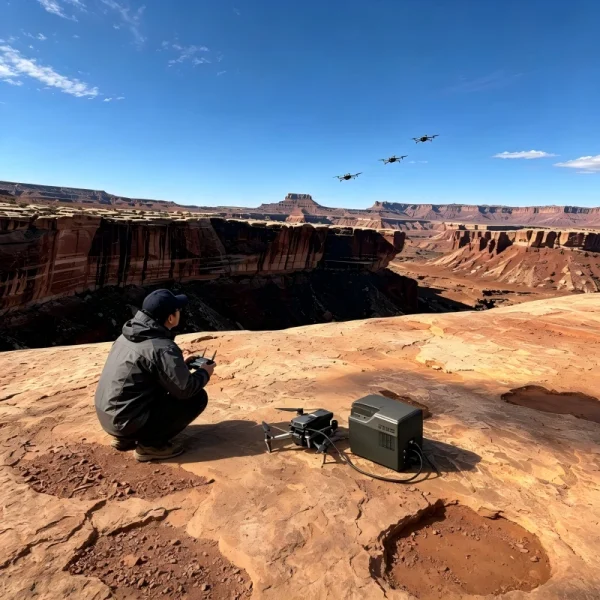
For field operations, a portable hydrogen fuel-cell system can instead be used as UAV ground power for battery charging and other ground-support requirements.

SOLIDHYDRO’s HYDRA-M 120W solid-state metal hydride fuel cell system is designed for portable power applications and can support UAV ground charging where the system requirements are compatible.

This architecture separates the energy-generation system from the aircraft itself:

Solid-State Hydrogen Storage → Fuel Cell → Ground Power → UAV Battery Charging

This can be useful when UAV operators need portable power at remote operating locations without relying entirely on fixed electrical infrastructure.

UAV Fuel Cell Solutions for Different Mission Profiles

Different UAV missions require different power architectures.

UAV MissionPotential Power ArchitectureSOLIDHYDRO Solution
Long-endurance onboard flight Fuel cell + hydrogen storage + optional battery HYDRA-G 3.3kW
Multirotor endurance Fuel cell + battery hybrid HYDRA-G 3.3kW
VTOL UAV Fuel cell + battery hybrid HYDRA-G 3.3kW
Fixed-wing long-endurance UAV Continuous fuel-cell power HYDRA-G 3.3kW
UAV battery charging in the field Portable fuel-cell ground power HYDRA-M 120W
Remote UAV operations Portable ground power or onboard fuel-cell architecture HYDRA-M / HYDRA-G

The final selection should be based on the UAV’s required power, endurance, payload, storage architecture, and integration constraints.

Why Choose SOLIDHYDRO for UAV Hydrogen Power?

SOLIDHYDRO develops hydrogen fuel-cell systems for applications ranging from portable field power to higher-power onboard systems.

Our UAV-related solutions cover different points in the UAV energy ecosystem:

Core2

Onboard UAV Power

HYDRA-G 3.3kW provides an air-cooled PEM fuel-cell platform for onboard UAV power and propulsion applications.

UAV Ground Power

HYDRA-M 120W combines solid-state metal hydride hydrogen storage with fuel-cell power for portable applications such as UAV ground power and battery charging.

1 Higher Energy Density

UAV System Engineering

Selecting the right fuel-cell architecture requires more than choosing a rated power.

SOLIDHYDRO can support evaluation of UAV power requirements, system architecture, hydrogen storage, integration conditions, and application-specific configurations.

Frequently Asked Questions

Q: What is a hydrogen fuel cell for a UAV?

A UAV hydrogen fuel cell is an electrochemical power system that converts hydrogen into electricity for an aircraft’s propulsion system and onboard electrical loads.

Depending on the architecture, the fuel cell can provide onboard continuous power or be used as a ground power source for UAV battery charging.

Yes. A properly designed fuel-cell system can provide onboard electrical power for UAV propulsion.

For example, HYDRA-G 3.3kW is designed for onboard UAV power and propulsion applications.

A hybrid battery may also be used to provide additional peak power.

An onboard fuel-cell system is installed on the aircraft and supplies electrical power during flight.

A ground-power system remains on the ground and can be used to recharge UAV batteries or provide electrical power for field operations.

SOLIDHYDRO addresses both architectures with different product platforms.

Not necessarily, but a battery can be useful in many UAV architectures.

A battery can provide peak power during takeoff, acceleration, or other transient conditions while the fuel cell supplies continuous power.

The final architecture depends on the UAV’s propulsion system and mission requirements.

There is no single flight-time figure for all hydrogen fuel cell UAVs.

Endurance depends on the aircraft’s average power consumption, hydrogen quantity, fuel-cell efficiency, system weight, payload, flight profile, and operating conditions.

The correct approach is to size the complete aircraft energy system around the target mission.

Hydrogen fuel-cell systems can be evaluated for BVLOS applications where extended endurance and continuous power are important.

Actual suitability depends on the UAV platform, regulatory requirements, aircraft certification, power architecture, and mission profile.

HYDRA-M is positioned primarily for portable power and UAV ground-power applications, including battery charging.

Direct onboard integration is a separate system-design question and depends on the aircraft’s power requirements, weight budget, installation space, and operating architecture.

For onboard UAV propulsion applications, see HYDRA-G 3.3kW.

The required fuel-cell power depends on the UAV’s continuous electrical load and the role of the fuel cell within the overall power architecture.

Before selecting a system, determine:

  • Average flight power
  • Peak propulsion power
  • Payload power
  • Target endurance
  • UAV weight
  • Hydrogen storage capacity
  • Battery requirements

SOLIDHYDRO can evaluate the requirements for a specific UAV platform and mission profile.

Request a UAV Hydrogen Fuel Cell Solution

Choosing a hydrogen fuel-cell system is an engineering decision based on your UAV's power demand, endurance target, aircraft configuration, payload, hydrogen storage, and operating environment.Tell us about your UAV platform and mission requirements, and our integration engineers can help identify a suitable power architecture.

Talk to SOLIDHYDRO

Need technical information, product specifications or application support? Contact our engineering team.

Whatsapp

+86 19813722676

Socials

Click or drag files to this area to upload.You can upload up to 5 files.